




Apr 30, 2026
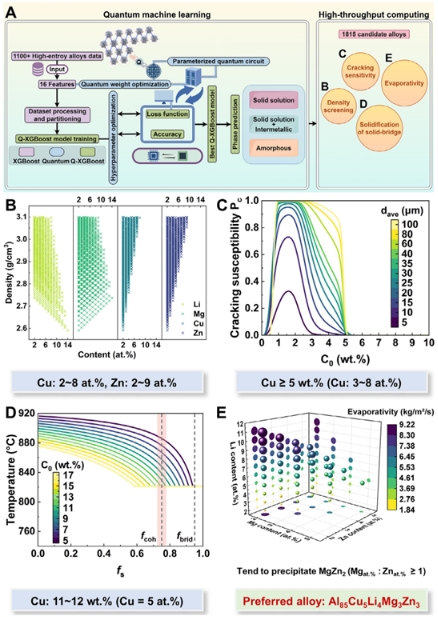
Recently, Prof. Jianzhong Jiang’s group at Fuyao University of Science and Technology, collaborating with the University of Science and Technology Beijing and the National University of Singapore, has published a landmark study in the top-tier materials journal Advanced Science. By integrating quantum machine learning (QML) and high-throughput computation, the team rationally designed a printable lightweight Al-based entropy alloy Al₈₅Cu₅Li₄Mg₃Zn₃, which overcomes hot cracking in additive manufacturing and achieves an unprecedented combination of ultrahigh strength, remarkable plasticity, excellent heat resistance, and low density—ideal for structural components in aerospace and extreme environments.
A long-standing bottleneck in advanced manufacturing is that conventional high-strength Al alloys suffer from severe hot cracking during laser additive manufacturing, while printable alloys exhibit rapid strength degradation at elevated temperatures. To resolve this dilemma, the team established a data-driven materials design paradigm and efficiently screened the optimal composition from over 1800 candidates. Using selective laser melting (SLM), brittle micrometer-sized intermetallic compounds were in-situ transformed into a deformable hierarchical nanostructure, featuring nanosized cellular eutectics, quasicrystalline phases, and dense planar defects including stacking faults, nanotwins, and 9R phases.
The as-printed alloy delivers world-class comprehensive performance:
· A record-high compressive strength >1000 MPa with ~20% compressive plasticity at room temperature, breaking the strength–ductility trade-off;
· Outstanding heat resistance, retaining >800 MPa compressive strength at 200 °C with a yield strength retention ratio of 95%;
· A high specific strength of 350×10³ N·m/kg, comparable to many high-performance titanium alloys;
· Near-full densification (~99.99%) and completely crack-free printability.
Notably, the alloy exhibits a controllable quasicrystal-to-crystal phase transformation upon thermal exposure. After annealing at 400 °C, it achieves 921 MPa compressive strength and 34% plasticity, offering a new route for post-fabrication property tuning. Multi-scale characterization and theoretical calculations reveal that the exceptional performance originates from synergistic effects: nanosized eutectic networks, low-stacking-fault-energy-induced nanostructures, and heterogeneous deformation-induced (HDI) strengthening.
This work pioneers the integration of data-driven design, entropy alloy engineering, and additive manufacturing, providing an original strategy to resolve the printability–heat-resistance conflict in high-strength Al alloys. It also establishes a universal framework for the high-throughput development and industrial application of advanced lightweight structural materials.
This research was supported by the National Natural Science Foundation of China, Fuzhou Science and Technology Program, and the Key Laboratory of Silicon-Based Materials (Ministry of Education).
DOI: 10.1002/advs.202522817


No. 104, Zhihui Avenue, Fuzhou High-tech Industrial Development Zone, Fujian Province

University Office: 0591-62180087 Undergraduate Admissions Office: 0591-62180153

office@fyust.edu.cn








© 2025 FYUST 104 Zhihui Avenue, High-Tech Zone, Fuzhou, Fujian, China 350109 Email: office@fyust.edu.cn Tel: +86 (0)591-62180087


