



Apr 30, 2026
Recently, Prof. Jianzhong Jiang’s team from the School of Advanced Materials and New Energy at Fuyao University of Science and Technology, collaborating with top research institutes worldwide, has published a groundbreaking work in Energy & Environmental Science (IF≈40), a top journal in energy and environment. The paper is entitled Breaking Linear Scaling Relationships in Acidic Water Oxidation via Engineered Molecular Co-catalyst.
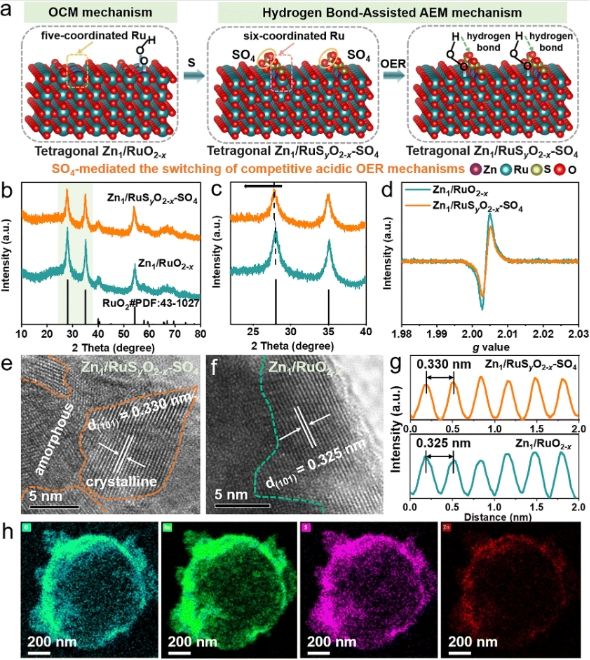
This study addresses the critical bottlenecks facing RuO₂ catalysts in proton exchange membrane water electrolysis (PEMWE): poor stability, inherent linear scaling relationships, and the inability to achieve both high activity and long durability. The team pioneered a cation–anion coanchoring strategy for oxyanions and successfully developed a sulfatemodified, Zn singleatom and S codoped ruthenium oxide catalyst (Zn/RuSᵧO₂₋ₓSO₄), delivering a leap in acidic oxygen evolution reaction (OER) performance.
The team innovatively employed singleatomic Zn and lattice S as a cation–anion pair to firmly anchor SO₄²⁻ onto the catalyst surface through strong coordination and electronic effects, solving the longstanding issue of easy leaching of surface oxyanions.
In situ characterizations and theoretical calculations confirm that the anchored SO² forms hydrogen bonds with the key *OOH intermediate, switching the mechanism from oxygen coupling mechanism (OCM) to hydrogenbondassisted adsorbate evolution mechanism (HBAEM). This directly breaks the linear scaling limitation and drastically lowers the energy barrier of the ratedetermining step.
Meanwhile, SO₄²⁻ enhances water adsorption and activation, and increases the energy cost for lattice oxygen loss and Ru dissolution, fundamentally strengthening structural stability.
The optimized Zn₁/RuSᵧO₂₋ₓSO₄ catalyst achieves world leading performance:
· An ultralow overpotential of 158 mV at 10 mA cm⁻² in 0.5 M H₂SO₄;
· A small Tafel slope of 50.0 mV dec⁻¹, revealing fast kinetics;
· Outstanding stability with negligible decay over 235 hours of continuous operation, far exceeding commercial RuO₂;
· A low cell voltage of 1.651 V at 1 A cm⁻² in a PEMWE, showing strong industrial potential.
This work establishes, for the first time, a trilateral regulation system: single atom doping – lattice anion – surface oxyanion. It provides a new paradigm to overcome the activity–stability trade off of Ru based acidic OER catalysts and lays a key scientific foundation for low cost, largescale green hydrogen production via PEM water electrolysis.
This research was supported by the National Natural Science Foundation of China, the Taishan Scholar Program of Shandong Province, and other grants.


No. 104, Zhihui Avenue, Fuzhou High-tech Industrial Development Zone, Fujian Province

University Office: 0591-62180087 Undergraduate Admissions Office: 0591-62180153

office@fyust.edu.cn








© 2025 FYUST 104 Zhihui Avenue, High-Tech Zone, Fuzhou, Fujian, China 350109 Email: office@fyust.edu.cn Tel: +86 (0)591-62180087


