




Apr 30, 2026
Recently, Prof. Jianzhong Jiang’s team from Fuyao University of Science and Technology, collaborating with Prof. Jinbao Zhang and Prof. Li Yang from Xiamen University, has published a breakthrough study in ACS Applied Materials & Interfaces (SCI Top Tier), revealing the atomic-scale mechanism of nickel oxide (NiOₓ) hole-transport layer interface modification and providing a new strategy for fabricating high-efficiency, high-stability inverted perovskite solar cells (PSCs).
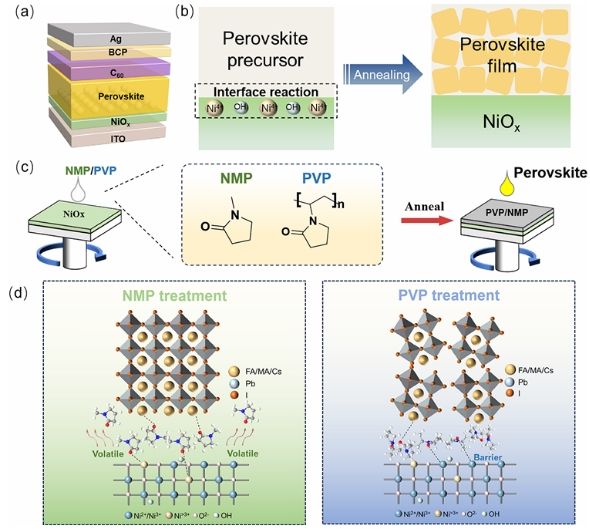
Nickel oxide (NiOₓ) is a promising inorganic hole-transport material for inverted PSCs owing to its wide bandgap, high optical transparency, and excellent chemical stability. However, abundant high-valence nickel defects and hydroxyl groups on the NiOₓ surface trigger severe interfacial side reactions with the perovskite layer, causing serious non-radiative recombination and performance degradation, which has become a critical bottleneck limiting device efficiency and lifespan.
To tackle this challenge, the team selected two structurally similar but dimensionally distinct modifiers: N-methylpyrrolidone (NMP, small molecule) and polyvinylpyrrolidone (PVP, polymer) for a systematic comparative study. The research confirmed that:
· PVP introduces strong steric hindrance and acts as a physical coating, forming an insulating layer that impedes charge transport and degrades perovskite crystallization.
· NMP enables directional chemical passivation through high reactivity and volatility, effectively reducing surface high-valence Ni⁴⁺, eliminating harmful hydroxyl (−OH) defects, and optimizing perovskite crystallization and interface contact.
As a result, the NMP-modified NiOₓ-based perovskite solar cells achieved outstanding performance:
· The power conversion efficiency (PCE) reached 20.89%;
· Trap density was drastically reduced, and dark current was suppressed by one order of magnitude;
· Unencapsulated devices retained 93% of their initial efficiency after 1800 hours of storage in nitrogen atmosphere at 25 °C.
This study reveals, for the first time, the intrinsic superiority of small-molecule chemical modification over polymer physical modification, providing universal guidance for the interface design of high-performance NiOₓ-based perovskite solar cells and promoting the industrial application of perovskite photovoltaics.
This work was supported by the National Natural Science Foundation of China and the Key Laboratory of Silicon-Based Materials (Ministry of Education).
DOI: 10.1021/acsami.6c01551


No. 104, Zhihui Avenue, Fuzhou High-tech Industrial Development Zone, Fujian Province

University Office: 0591-62180087 Undergraduate Admissions Office: 0591-62180153

office@fyust.edu.cn








© 2025 FYUST 104 Zhihui Avenue, High-Tech Zone, Fuzhou, Fujian, China 350109 Email: office@fyust.edu.cn Tel: +86 (0)591-62180087


