



Mar 10, 2026
Amid the global acceleration of carbon neutrality strategies and the large-scale deployment of the hydrogen energy industry, proton exchange membrane (PEM) water electrolysis has emerged as a mainstream technology for green hydrogen production due to its high efficiency, high purity, and compatibility with fluctuating renewable energy sources. However, the slow kinetics of the anodic oxygen evolution reaction (OER) and the heavy reliance of commercial catalysts on the scarce precious metal iridium (Ir) have become critical bottlenecks restricting cost reduction and large-scale application of green hydrogen. Developing low-cost, highly active, and stable non-precious metal acidic OER catalysts has become a worldwide research focus in the field of energy catalysis.
Against this background, the research team led by Prof. Xiao Dequan from the School of Advanced Materials and New Energy, Fuyao University of Science and Technology, collaborated with the team of Prof. Li Gao from Inner Mongolia Normal University. They precisely controlled the hydrolysis of iron nitrate precursors using sodium nitrate, in-situ generating ultra-small, highly dispersed FeO nanocrystallites tightly anchored on the surface of amorphous Mn₃CoOₓ matrix with abundant defects and flexible local environments, forming a strongly coupled heterostructured interface.
Electrochemical measurements demonstrated that the as-prepared FeO/Mn₃CoOₓ catalyst exhibited outstanding electrocatalytic performance for the oxygen evolution reaction in 0.5 M H₂SO₄ acidic electrolyte. At a current density of 10 mA cm⁻², it achieved an overpotential of merely 252 mV, with a Tafel slope as low as 79 mV dec⁻¹, indicating significantly accelerated reaction kinetics. Its catalytic performance outperformed the commercial IrO₂ catalyst (ca. 290 mV @ 10 mA cm⁻²) comprehensively.
Mechanistic studies revealed a strong interfacial electronic interaction between FeO nanocrystallites and the amorphous Mn₃CoOₓ matrix, which efficiently accelerated charge transport and stabilized catalytic intermediates. More importantly, the introduction of FeO stabilized high-valence catalytic intermediates and induced a catalytic mechanism transition from a sole lattice oxygen-mediated mechanism (LOM) to a synergistic combination of LOM and oxygen pathway mechanism (OPM), fundamentally overcoming the activity–stability trade-off of conventional acidic OER catalysts.
This conclusion was rigorously verified by multi-scale characterization and theoretical simulations, including structural characterizations (XRD, XPS, STEM) of the catalyst after long-term acidic OER stability tests, in-situ reaction process analysis via differential electrochemical mass spectrometry (DEMS), and mechanistic calculations using density functional theory (DFT), providing consistent experimental and theoretical evidence supporting the reliability of the findings.
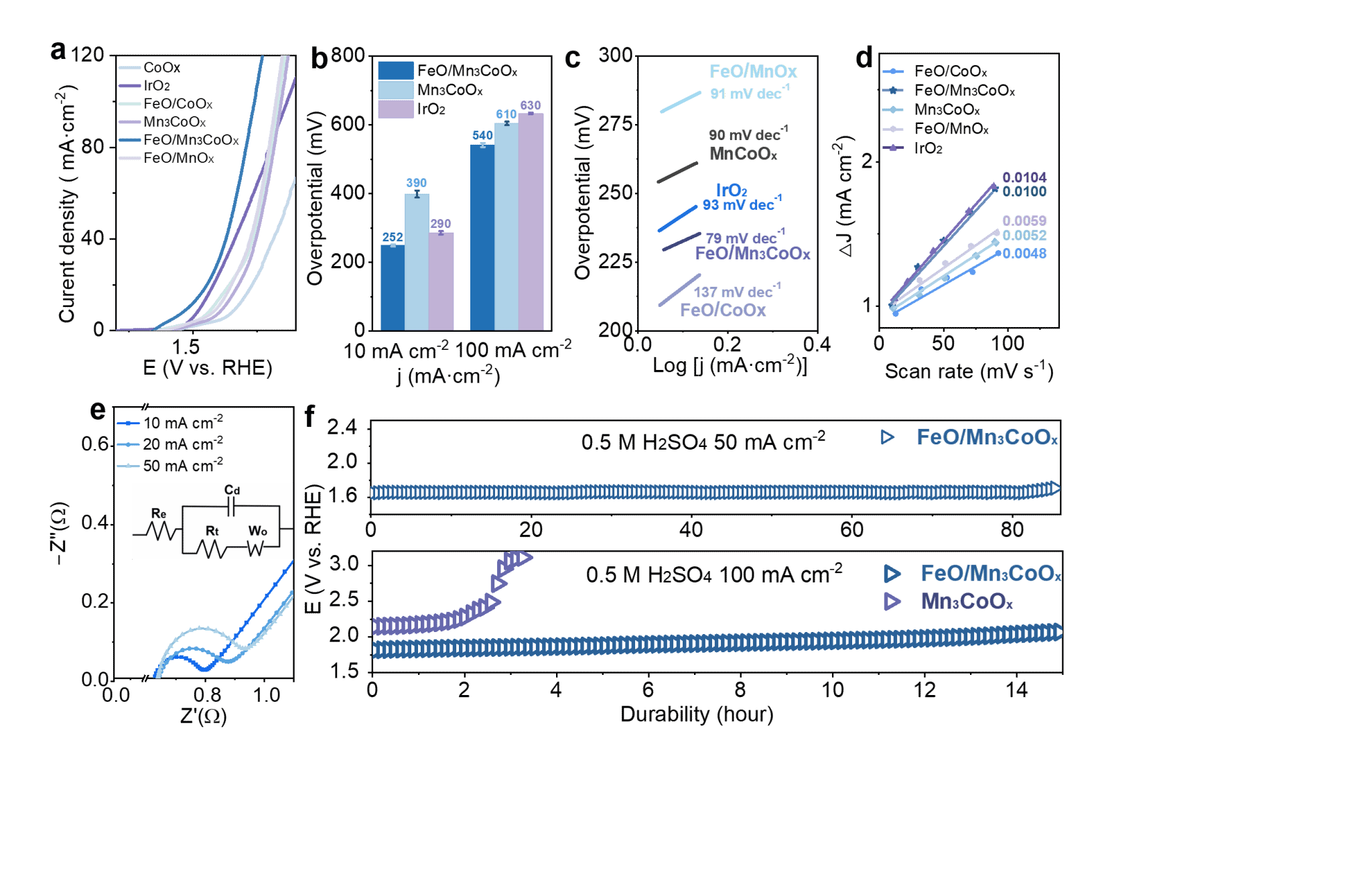
Figure 1: (a) Polarization curves of FeO/Mn3CoOx, Mn3CoOx and reference samples in a 0.5 M H2SO4 (pH 0) solution. (b) Overpotentials, (c) Tafel plots, (d) Cdl values, and (e) Nyquist plots (@Ej=10, 20, 50) of FeO/Mn3CoOx. (f) Potential required to reach 50 and 100 mA cm−2 in 0.5 M H2SO4 for FeO/Mn3CoOx measured using chronopotentiometry holds.
Related research results were published in the internationally renowned journal Angewandte Chemie International Edition, online available at: https://doi.org/10.1002/anie.202523620. This work not only developed a high-performance amorphous, non-precious metal acidic OER catalyst but also established a versatile materials design strategy, offering a new pathway to reduce reliance on precious metals and enhance the efficiency of PEM water electrolysis. The journal is a top international chemical journal hosted by the Gesellschaft Deutscher Chemiker (GDCh), covering interdisciplinary research in chemistry, biology, materials science, physics, and engineering.


No. 104, Zhihui Avenue, Fuzhou High-tech Industrial Development Zone, Fujian Province

University Office: 0591-62180087 Undergraduate Admissions Office: 0591-62180153

office@fyust.edu.cn








© 2025 FYUST 104 Zhihui Avenue, High-Tech Zone, Fuzhou, Fujian, China 350109 Email: office@fyust.edu.cn Tel: +86 (0)591-62180087


