




Oct 20, 2025
The field of sodium-ion batteries (SIBs) urgently demands resource-sustainable cathode materials with high energy density to meet the growing demand for grid-scale energy storage. Iron-based materials (e.g., Na₂FeP₂O₇, Na₄FeV(PO₄)₃) represent an important category owing to their low cost, yet suffer from relatively low energy density. Partial substitution of Fe with Mn in the host structure can effectively boost performance, benefiting from the rich valence states of Mn (Mn²⁺/³⁺/⁴⁺) and its high redox potential. However, most Mn-based materials (e.g., Na₂Mn₀.₅Fe₀.₅P₂O₇, Na₂MnP₂O₇, Na₄MnV(PO₄)₃) are limited by insufficient Mn redox activity, leading to rapid capacity fading and poor rate capability. These issues mainly arise from the Jahn–Teller (JT) effect and severe lattice distortion induced by high-spin Mn³⁺ (t₂g³ eg¹). Although ion doping and surface coating have been widely applied, they cannot fundamentally eliminate these detrimental effects. Recent studies indicate that materials of the Na₄MnₓFe₃₋ₓ(PO₄)(P₂O₇) family exhibit promising electrochemical activity and cycling stability, yet the understanding of their reaction mechanisms remains incomplete.
Against this background, the team of Prof. Jiang Jianzhong and Assistant Prof. Li Huangxu from the School of Advanced Materials and New Energy, Fuyao University of Science and Technology (FYUST), collaborated with the team of Prof. Huang Haitao from The Hong Kong Polytechnic University (PolyU). Using a combination of characterization techniques including in-situ XRD, in-situ EIS, ex-situ XAS, and theoretical calculations, they revealed the key mechanism by which Na₄Mn₁.₅Fe₁.₅(PO₄)(P₂O₇) (NMFPP) enables simultaneously highly active Fe²⁺/³⁺ and Mn²⁺/³⁺ redox reactions.
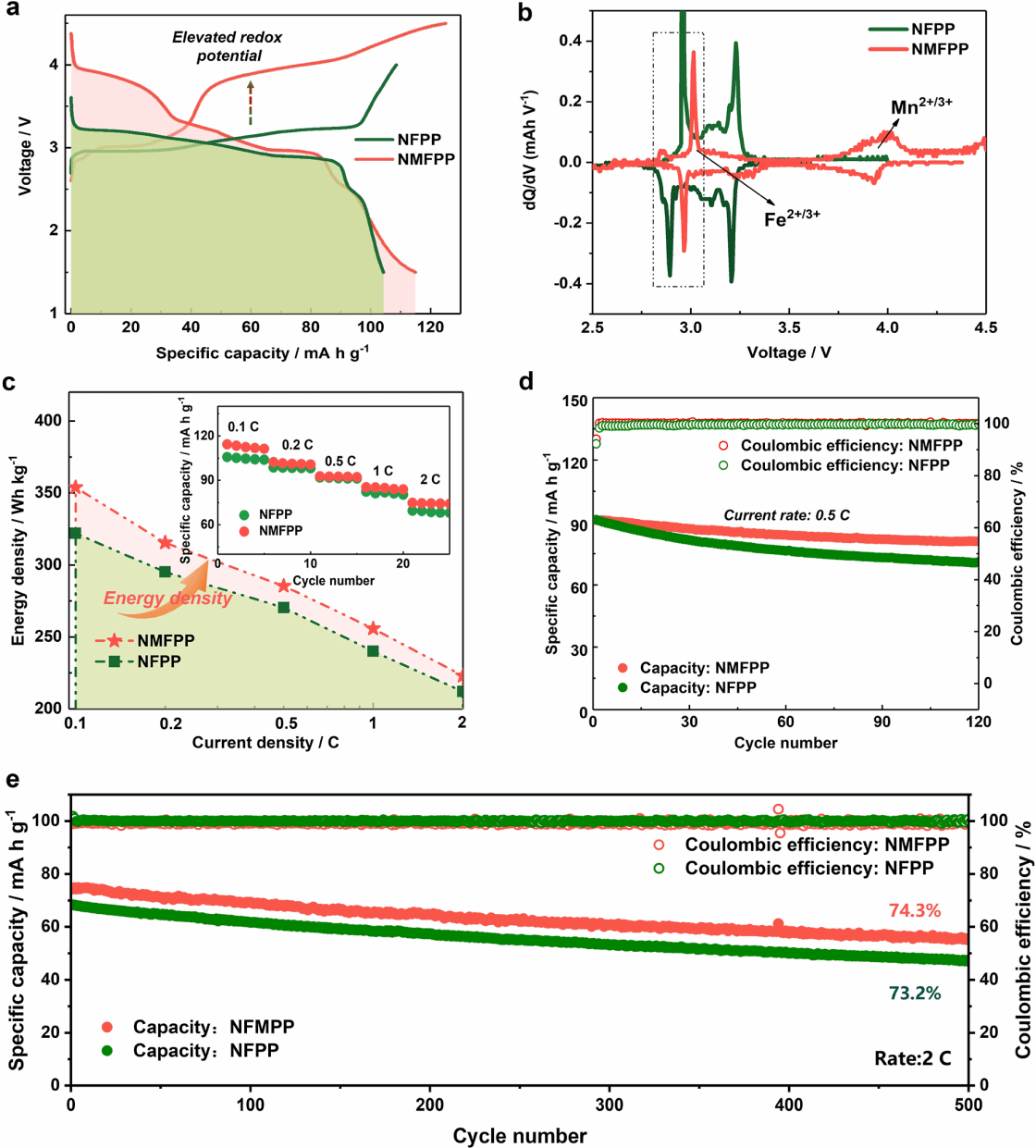
It was found that Mn substitution reduces the covalency of the Fe−O bond and elevates the Fe²⁺/³⁺ redox potential, thereby enhancing the energy density. Furthermore, during Na⁺ extraction, the JT effect induces splitting of the Mn eg orbitals, narrowing the band gap and promoting electron transfer. Computational and experimental results reveal that the lattice distortion in NMFPP is anisotropic, creating expanded Na⁺ diffusion pathways along the a-axis and lowering the diffusion energy barrier. This lattice distortion is reversible during Na⁺ storage, with a volume change of only 4.93%. These features endow NMFPP with outstanding high-rate capability and cycling stability.
The relevant research results were published in the internationally renowned journal ACS Nano (DOI: https://doi.org/10.1021/acsnano.5c12007). This work provides critical insights into the regulation of transition-metal redox potentials and the efficient activation of Mn, facilitating the development of novel high-energy cathode materials for sodium-ion batteries. ACS Nano is a top journal in nanoscience and technology published by the American Chemical Society (ACS), covering interdisciplinary research in chemistry, biology, materials science, physics, and engineering.


No. 104, Zhihui Avenue, Fuzhou High-tech Industrial Development Zone, Fujian Province

University Office: 0591-62180087 Undergraduate Admissions Office: 0591-62180153

office@fyust.edu.cn








© 2025 FYUST 104 Zhihui Avenue, High-Tech Zone, Fuzhou, Fujian, China 350109 Email: office@fyust.edu.cn Tel: +86 (0)591-62180087


