




Nov 19, 2025
As one of the primary dynamic behaviors in metallic glasses, the β-relaxation exerts a profound influence on the mechanical properties, structural stability, and glass transition process of the materials. Although this phenomenon has been discovered for several decades, its microstructural origin and physical mechanism have long remained a major puzzle in the academic community due to the lack of direct experimental evidence.
To address this challenge, the research team led by Prof. Jiang Jianzhong from the School of Advanced Materials and New Energy at Fuyao University of Science and Technology, in collaboration with Associate Prof. Wang Xiaodong from Zhejiang University and Dr. Bao Zhiwen from the National Synchrotron Radiation Research Center, has published a research paper entitled Atomic-Level Structural Characteristics of β-Relaxation in Metallic Glasses in the international journal Advanced Science. Prof. Jiang Jianzhong (Fuyao University of Science and Technology), Associate Prof. Wang Xiaodong (Zhejiang University), and Dr. Bao Zhiwen (National Synchrotron Radiation Research Center) serve as co-corresponding authors.
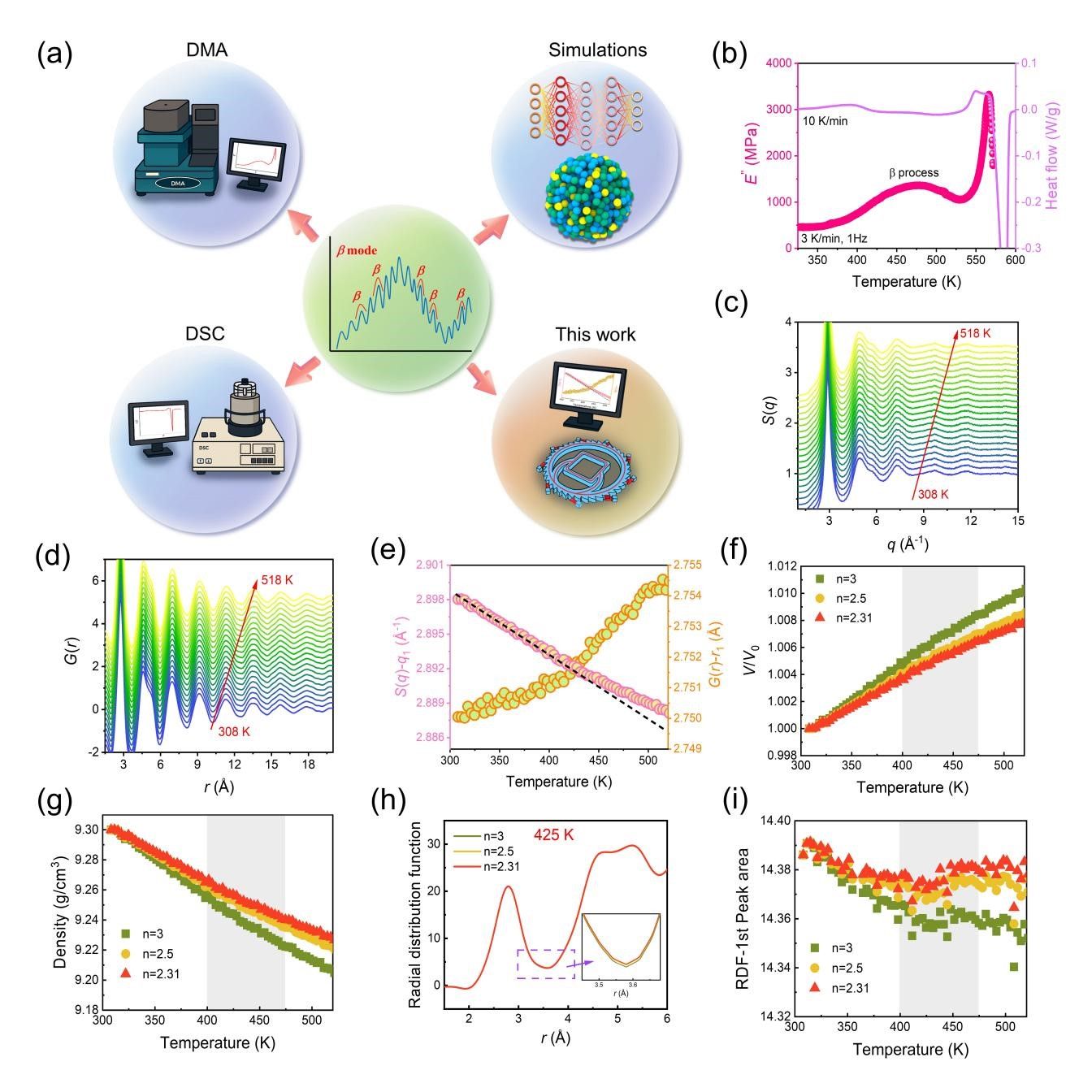
The research team innovatively adopted a multi-scale approach combining in-situ synchrotron high-energy X-ray diffraction (HEXRD), X-ray absorption fine structure (XAFS) spectroscopy, and ab initio molecular dynamics (AIMD) simulations. For the first time, they successfully captured the dynamic structural signals during the β-relaxation process at the atomic scale and revealed its intrinsic correlation with local atomic packing and chemical environment (Figures 1–3). In this study, Pd₄₀Cu₄₀P₂₀ metallic glass, which exhibits pronounced β-relaxation behavior, was selected as the model system.
Through precise thermodynamic (differential scanning calorimetry, DSC) and dynamic (dynamic mechanical analysis, DMA) characterizations, combined with in-situ high-temperature HEXRD and XAFS experiments, the team discovered that when the temperature rises to the β-relaxation activation region (approximately 425 K), synchronous and non-linear “inflection points” appear in the peak positions of the structure factor S(q) and pair distribution function G(r), the volume and density of the system, and the nearest-neighbor coordination number. This series of findings provides, for the first time, direct in-situ structural experimental evidence for β-relaxation corresponding to thermo-dynamic responses.
To further uncover the microscopic mechanism, the team systematically compared multiple metallic glass systems with pronounced and weak β-relaxation behaviors via molecular dynamics simulations (Figures 4–5). It was found that the nature of β-relaxation is closely related to the presence of fast-moving atoms in the system. These atoms typically possess more free volume, lower coordination numbers, longer average bond lengths, and tend to be surrounded by specific Voronoi polyhedra, such as the tricapped trigonal prism <0,3,6,0>.
A key breakthrough of this study is the revelation of the determinative role of local chemical environment. In Pd₄₀Cu₄₀P₂₀, phosphorus (P) atoms preferentially bond with palladium (Pd), resulting in weaker chemical constraints around copper (Cu) atoms and the formation of looser, more mobile local structures. In contrast, in Pd₄₀Ni₄₀P₂₀, which shows insignificant β-relaxation, the stronger nickel–phosphorus (Ni–P) bonds significantly restrict atomic motion. This indicates that specific chemical bonding and atomic packing collectively constitute the structural basis for β-relaxation.
In addition, through elaborate cyclic heating and annealing experiments, the team structurally confirmed that β-relaxation exhibits both irreversible and reversible characteristics: heating above the β-relaxation temperature region eliminates its structural signal due to irreversible free volume annihilation, while high-temperature “rejuvenation” treatment can partially restore the relaxation behavior. This provides a new perspective for understanding and regulating the nature of β-relaxation.
This research establishes, for the first time via in-situ experimental methods, a direct correlation between β-relaxation and atomic-scale structural evolution, advancing the understanding of this phenomenon from macroscopic properties and dynamics to the microscopic atomic structure level. It lays a solid theoretical and experimental foundation for rationally designing local chemical environments and atomic packing to regulate the relaxation behavior and mechanical properties of metallic glasses.
The relevant important findings are published in Advanced Science (DOI: https://doi.org/10.1002/advs.202518424), a prestigious high-impact journal published by Wiley, covering multidisciplinary fields including materials science, physics, chemistry, life sciences, and engineering, renowned for its cutting-edge research and influence.


No. 104, Zhihui Avenue, Fuzhou High-tech Industrial Development Zone, Fujian Province

University Office: 0591-62180087 Undergraduate Admissions Office: 0591-62180153

office@fyust.edu.cn








© 2025 FYUST 104 Zhihui Avenue, High-Tech Zone, Fuzhou, Fujian, China 350109 Email: office@fyust.edu.cn Tel: +86 (0)591-62180087


