




Dec 11, 2025
As a zero-carbon, eco-friendly energy carrier with high energy density, hydrogen is regarded as one of the ideal solutions to global energy crises and environmental pollution. However, conventional water electrolysis for hydrogen production suffers from critical bottlenecks, including slow kinetics of the anodic oxygen evolution reaction (OER), high membrane costs, and poor durability, which severely restrict its large-scale application.
To address these challenges, Prof. Jiang Jianzhong’s research group from the School of Advanced Materials and New Energy at Fuyao University of Science and Technology published a research paper entitled Lattice‐Confined Ru Clusters Driving Efficient Hydrazine‐Assisted Membrane‐Free Hydrogen Production in the internationally renowned journal Advanced Energy Materials.
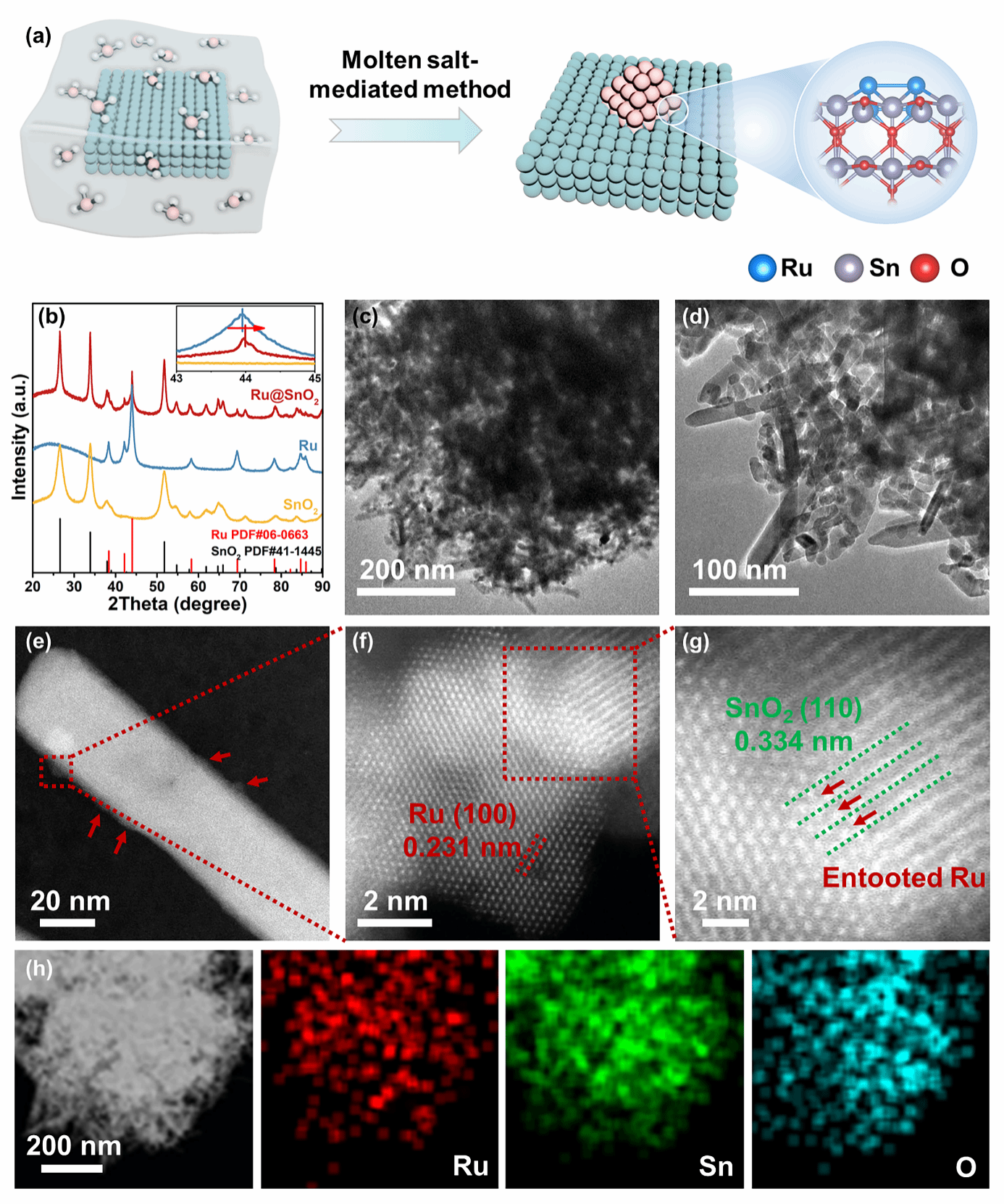
Using an innovative molten-salt-assisted strategy, the team successfully synthesized a supported catalyst (Ru@SnO₂) in which ruthenium clusters are partially embedded into the SnO₂ lattice. This unique lattice-confined structure offers the dual advantages of strong metal–support interaction and high exposure of active sites, effectively resolving the inherent trade-off between activity and stability in conventional supported catalysts.
In alkaline media, Ru@SnO₂ exhibits outstanding bifunctional electrocatalytic performance: it requires only 9 mV overpotential to reach 10 mA cm⁻² for the hydrogen evolution reaction (HER) and −82 mV for the hydrazine oxidation reaction (HzOR). When applied in a two-electrode system, it delivers 100 mA cm⁻² at 0.074 V and operates stably for more than 1000 hours. Further integration into a membrane-free electrolysis system drives a high current density of 1.0 A cm⁻² at only 0.877 V, representing a 67.8% reduction in energy consumption compared with traditional anion exchange membrane electrolyzers (2.726 V).
To uncover the origin of its high performance, the team combined synchrotron X-ray absorption spectroscopy, high-resolution transmission electron microscopy, and density functional theory (DFT) calculations to systematically reveal the regulation mechanism of the lattice-confined structure on electronic structure and reaction pathways. The results show that:
· Confinement lowers the d-band center of Ru, optimizing the hydrogen adsorption free energy;
· A pronounced work function difference at the interface induces a built-in electric field, accelerating water dissociation;
· Hydrazine adsorbs in an end-on bidentate mode on the Ru@SnO₂ surface, significantly boosting oxidation efficiency.
This research not only provides a new strategy for designing high-performance bifunctional electrocatalysts with low precious-metal loading but also lays a solid theoretical and experimental foundation for developing membrane-free, low-energy-consumption hydrogen production systems.
The related findings are published in Advanced Energy Materials (DOI: https://doi.org/10.1002/aenm.202504762), a leading journal in energy materials published by Wiley, renowned for its forward-looking perspective and high impact.


No. 104, Zhihui Avenue, Fuzhou High-tech Industrial Development Zone, Fujian Province

University Office: 0591-62180087 Undergraduate Admissions Office: 0591-62180153

office@fyust.edu.cn








© 2025 FYUST 104 Zhihui Avenue, High-Tech Zone, Fuzhou, Fujian, China 350109 Email: office@fyust.edu.cn Tel: +86 (0)591-62180087


