


Aug 6, 2025
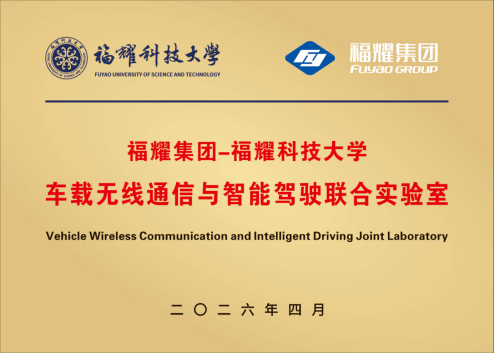
Fuyao University of Science and Technology and Fuyao Group have jointly established the Vehicle Wireless Communication and Intelligent Driving Joint Laboratory to promote collaborative innovation in key technologies for intelligent connected vehicles. Oriented toward the future development needs of intelligent vehicles, the laboratory focuses on two major research tracks: UWB automotive electronics applications, and intelligent driving with V2X collaborative research. It aims to build a university-industry collaborative innovation platform integrating technology research and development, platform validation, talent cultivation, and technology transfer, providing sustained support for key technology research and engineering applications in intelligent connected vehicles.
I. Building on University-Industry Collaboration to Serve the Development of Key Technologies for Intelligent Connected Vehicles
The Vehicle Wireless Communication and Intelligent Driving Joint Laboratory is jointly established by Fuyao Group and Fuyao University of Science and Technology. Oriented toward the development needs of the intelligent vehicle industry, the laboratory conducts systematic research on automotive wireless communication applications, collaborative perception, fusion-based decision-making, scenario validation, and application demonstrations.
With "platform development, technology research and development, talent cultivation, and technology transfer" as its core missions, the laboratory is committed to forming a complete R&D chain covering algorithm research, system development, simulation validation, and prototype demonstration. It will provide sustained support for the university's related disciplinary development and the enterprise's forward-looking technology strategy.
Leveraging the strengths of university-industry collaboration, the laboratory not only focuses on fundamental theory and key algorithm research, but also emphasizes engineering implementation and application validation. It aims to build an intelligent connected vehicle technology platform with sustained R&D capability, system validation capability, and industrial support capability.
II. Focusing on Two Major Research Tracks to Plan the Laboratory's Development
According to the latest development plan, the laboratory has formed a "dual-track" research layout centered on UWB automotive electronics applications and intelligent driving with V2X collaborative research.
The first research track is UWB automotive electronics applications. The laboratory will conduct research on high-precision ranging, CIR-based sensing, smartphone digital keys, in-cabin presence detection, kick sensing, and low-power sentinel mode. By fully leveraging UWB's advantages in high temporal resolution, multipath observability, centimeter-level positioning, and anti-spoofing security, the laboratory will promote the evolution of UWB from a "precise positioning tool" into a "digital sensing system" for vehicles.
The second research track is intelligent driving and V2X collaborative research. The laboratory will focus on vehicle-road-cloud collaborative perception and fusion-based decision-making, with key emphasis on typical collaborative scenarios such as V2V, V2I, V2N, and V2P. By overcoming the limitations of single-vehicle intelligence under line-of-sight obstruction, complex traffic conditions, and adverse environments, the laboratory will provide stronger global perception and proactive decision-making support for advanced intelligent driving.
III. Developing Verifiable, Demonstrable, and Transferable Technical Capabilities Around Typical Scenarios
In the field of UWB automotive electronics, the laboratory will focus on systematic research into applications such as smart entry and digital keys, security authentication, in-cabin vital-sign sensing, child presence detection, smart tailgate kick sensing, and low-power security monitoring. In particular, environmental-change recognition and subtle-motion sensing based on CIR feature extraction will provide key technical support for presence detection, security monitoring, and intelligent interaction.
In the field of intelligent driving and V2X, the laboratory will focus on core scenarios such as intersection collision warning, forward emergency braking warning, blind-spot assistance, delivery of traffic signal phase and timing information, intersection topology broadcasting, cloud-based route planning, OTA support, and protection of vulnerable road users. It will conduct key research on heterogeneous information access, multi-sensor spatiotemporal alignment, collision-risk assessment models, and warning-threshold calibration, promoting the transition from single-vehicle perception to collaborative perception, and from local decision-making to global collaborative decision-making.
IV. Building an End-to-End Platform to Integrate Research-Based Education and Engineering Validation
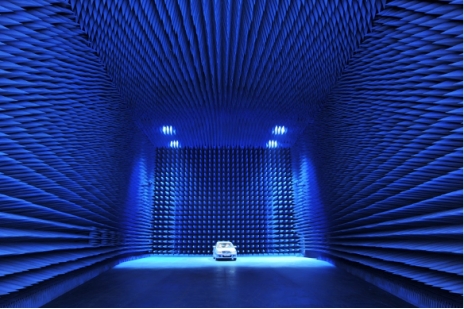
According to the plan, the joint laboratory will build a comprehensive validation platform covering campus roads, industrial park roads, and closed test scenarios. It will gradually establish end-to-end validation capabilities ranging from simulation analysis and hardware-in-the-loop simulation to real-vehicle road testing. Through continuous testing and iteration in real-world scenarios, the laboratory will accelerate the transition of key technologies from principle validation to system prototype development and application demonstration.
In terms of talent cultivation, the laboratory will rely on the collaborative mechanism between Fuyao University of Science and Technology and Fuyao Group to build a high-level practical teaching and research training platform. It will cultivate interdisciplinary automotive electronics talent with capabilities in hardware-software co-design, system integration, engineering validation, and technology transfer.
In terms of technology transfer, the laboratory will provide forward-looking technical support for the enterprise and promote the pre-installation application of UWB automotive electronics and intelligent driving collaborative technologies in next-generation intelligent connected vehicles.
V. Looking Ahead: Building an Influential Intelligent Connected Vehicle Technology Platform
Looking toward the future development cycle, Fuyao Group and Fuyao University of Science and Technology will continue to deepen their collaboration in automotive electronics, wireless communication applications, and intelligent driving collaborative technologies. They will continuously enhance the joint laboratory's R&D capability, validation capability, and industrial support capability, striving to build it into an influential domestic joint laboratory for intelligent connected vehicle technologies and to provide technical support and innovation momentum for the high-quality development of the intelligent connected vehicle industry.


No. 104, Zhihui Avenue, Fuzhou High-tech Industrial Development Zone, Fujian Province

University Office: 0591-62180087 Undergraduate Admissions Office: 0591-62180153

office@fyust.edu.cn







© 2025 FYUST 104 Zhihui Avenue, High-Tech Zone, Fuzhou, Fujian, China 350109 Email: office@fyust.edu.cn Tel: +86 (0)591-62180087


